|
|
 |
| Municipal Solutions«Speed Tables |
| |
|
|
|
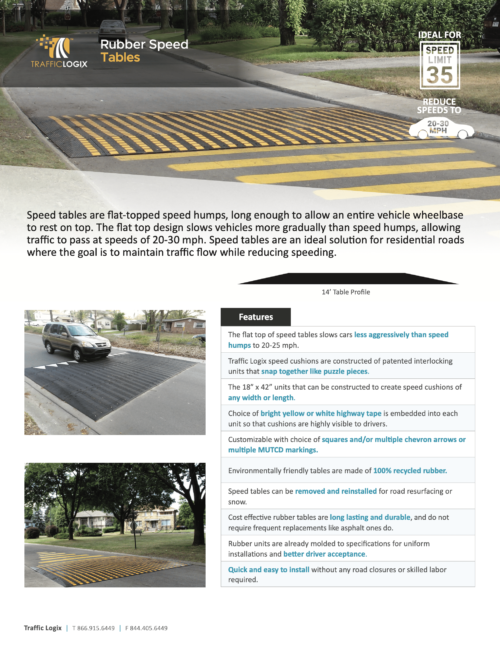
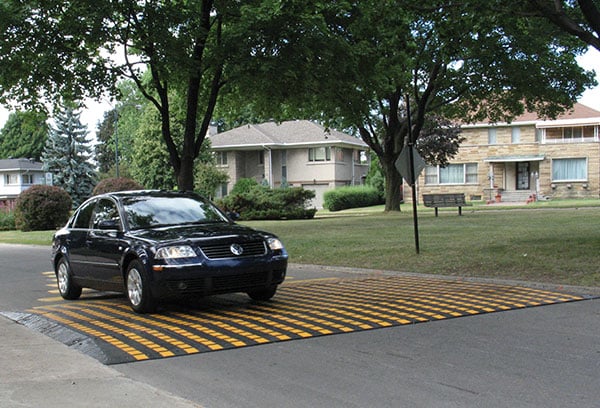
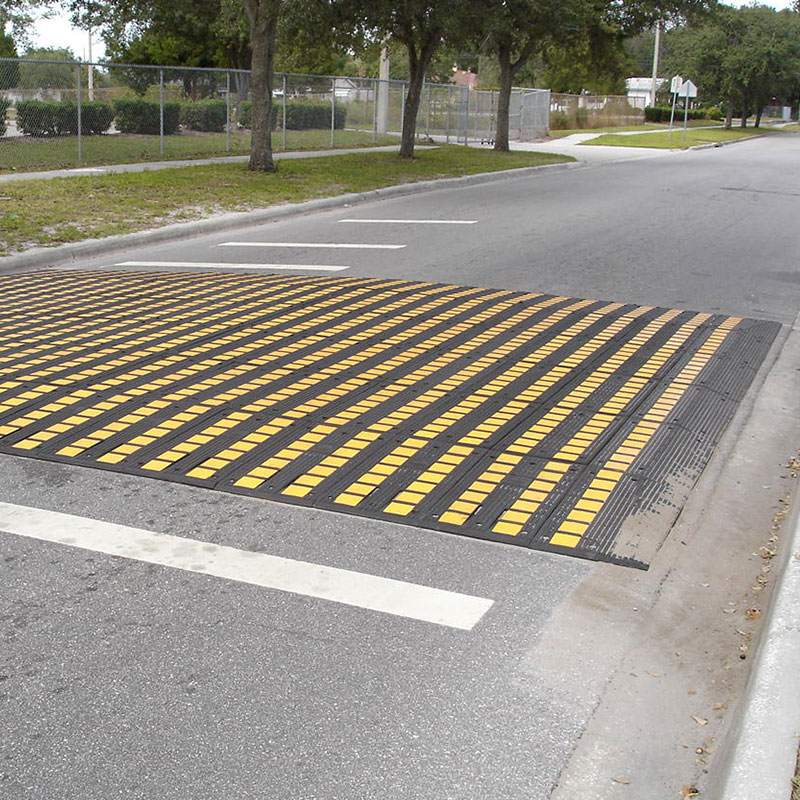
| Speed tables are flat-topped speed humps and are generally long enough for the entire wheelbase of a passenger car to rest on top. The design of speed tables allows for more gradual slowing of vehicle speed than humps. This makes speed tables the ideal solution for roads with typical residential speed limits. |
|
|
|
|
|
      |
|
|
|
|
|
|
 |
14' Speed Table Specs
Dimensions: 3" x 14' x 22.5' |
 |
21' Speed Table Specs
Dimensions: 3" x 21' x 22.5' |
|
While standard product sizes are shown, the interlocking devices
are fully customizable
to any length or road width. |
| Traffic Logix solutions have been installed in hundreds of locations across North America. |
|
|
|
|
|
|
printer friendly |
General description: |
Speed Humps and Speed Tables of various dimensions are
constructed using interlocking modules (US patent pending
12633-23USPR). The standard foot print dimensions of each
module are 18” by 42”. The weight of the various modules is
between 50 and 100 lbs.
Each unit is bolted to a paved road surface using six lag bolts
3/8” dia. through a plastic shield installed in the road surface.
The Traffic Logix proprietary two directional tongue and grove
interlocking system provides additional connection between the
modules and increases stability of the speed hump or speed
table. |
|
|
|
|
Dimensions of the modules: |
- width 18” (+/- 1/16”)
- length 42” (+/- 1/8”)
- thickness 3” (+/- 1/8”) |
|
|
|
|
Dimensions of the Speed Humps/Tables:
(width and length of
speed hump are adjustable) |
- width from 7’ up, by 3.5’ increments
- length: according to a street width, from 6’ by 1.5’ increments
- height: 3” or 4”
|
|
|
|
|
Standard dimensions of the Speed Humps/Tables: |
- width 7’, 14’, 21’
- length: according to a street width
- height: 3” or 4” |
|
|
|
|
Entrance and exit gradient: |
1:15 |
|
|
|
|
Side gradient: |
1:3 |
|
|
|
|
Material: |
Compression molded 100% recycled synthetic and natural
rubber composite |
|
|
|
|
Physical properties: |
- tensile strength: minimum 500 psi
- shore hardness: minimum 70A
- specific gravity 1.1 |
|
|
|
|
Marking: |
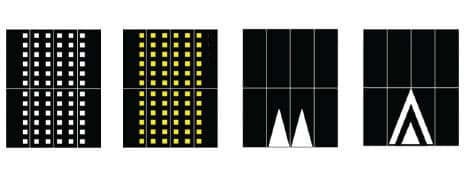
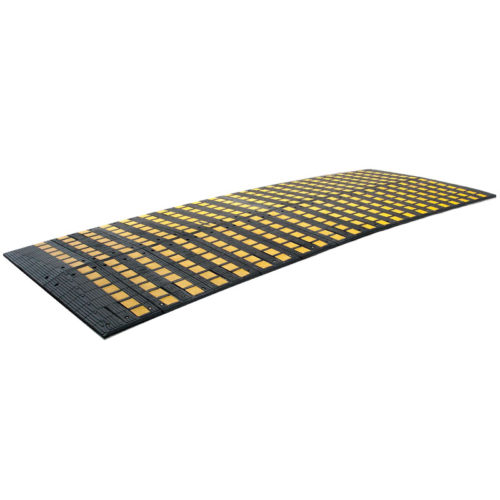
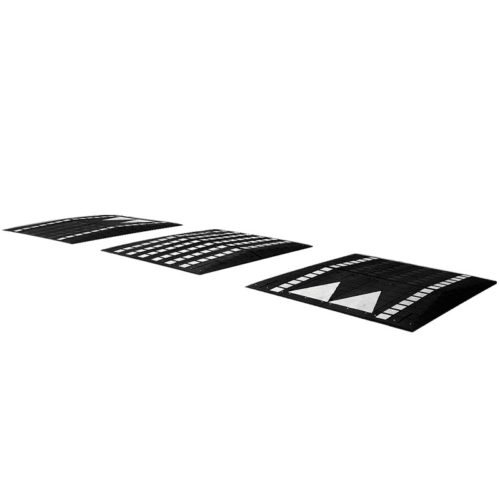
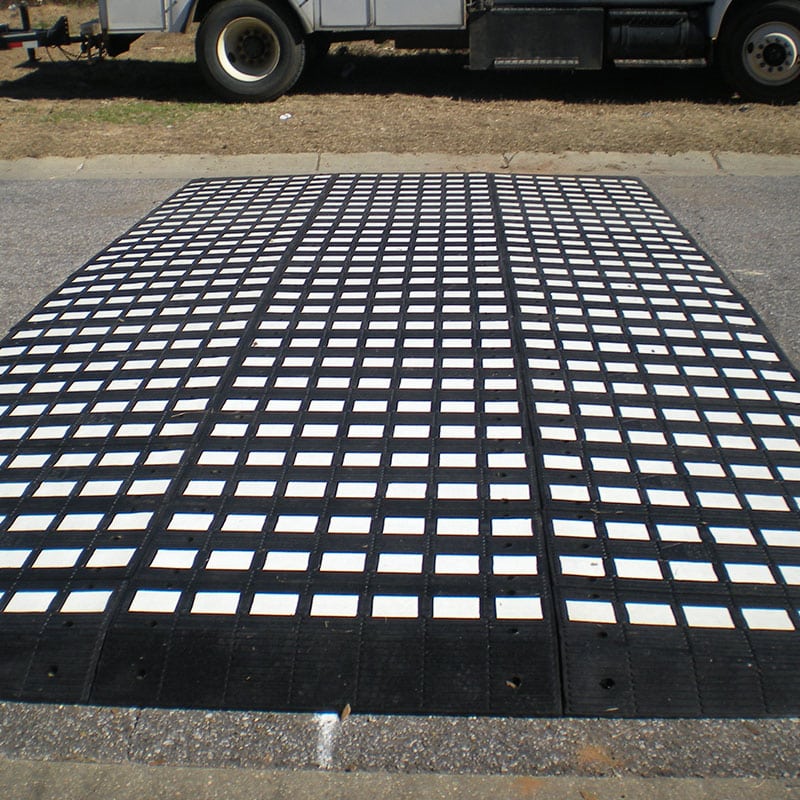
rubber modules are available in black or
black with yellow reflective tape or
black with white reflective tape |
|
|
|
|
Installation method: |
| - |
each module is affixed to the pavement with six zinc plated
steel lag bolts 3/8” x 4”, plastic polypropylene shields and
3/8” zinc plated steel washers supplied with the modules |
| - |
9/16” diameter holes are drilled through the holes in the
modules into a paved road. |
| - |
the plastic shields are installed in the mounting holes with
the provided installation tool |
| - |
the lag bolts are inserted into mounting holes and tightened
(do not over tighten the bolts) |
|
|
|
|
|
Installation tools: |
| - |
chalk line, measuring tape, heavy duty hummer drill, 9/16”
dia. by 10” long carbide tip drill bits, installation tool for
plastic shields, 11/16” drive socket with a power tool,
portable blower, utility knife, crow bars |
| - |
installation tool for the plastic shields is supplied for the initial
installation job only |
| - |
additional bolts, shields, washers, and installation tools can
be purchased from Traffic Logix |
|
|
|
|
|
Warranty: |
A two (2) year warranty is provided on all Speed Hump/Table
components installed as per the manufacturer’s installation
instructions. |
| |
|
|
|
|
|
|
| |
 |
| |

- Chalk
- Measuring tape
- Impact or hammer drills, we recommend that you have two heavy duty hammer drills
(Preferrably spline drills)
- High speed drills, we recommend that you have two electric drills
- Drill bits carbide tip, At least two 9/16" dia., 10-12" long
- 3lb Hammer
- 10lb Sledge hammer (for final adjustment)
- 11/16" drive socket with a12" extension
- Street broom
- Utility knife or a hack saw (used for trimming the rubber as needed)
- Crow bars, gooseneck wrecking bars
- Portable air compressor able to maintain 120psi (used to blow out the debris after the holes are drilled)
- Generator and extension cords to run all four drills
- One 24" 2"X4" piece of wood. This is used to knock the panels in place.
- Appropriate signage in accordance to ITE's State of the Practice on Traffic Calming as well as ITE's Manual on Uniformed Traffic Control Devices (MUTCD)

Step1.
Clean the surrounding installation area by using the street broom.
Step2.
Using the Chalk line mark a line parallel to the curb and one that is perpendicular to the road. Use these lines to square up your traffic calming device.

Step 3.
Identify and separate the pieces that run parallel to the curb for both sides of the device..
Step 4.
Assemble and position the first row of outside units. Make sure that all of the tongues are facing out towards the center of the device. Use the tongue and groove system to ensure the units interlocked properly as shown below.

Step 5.
Drill 9/16” diameter holes into the asphalt, through the existing holes of the first row using the hammer drill. The holes should be 3 1/2” to 4” deep in order to accommodate the plastic shields which are 3” long.

Step 6.
Use an air compressor remove all of the debris from the holes are clear of dust and debris. Compressor should be able to maintain 90psi
Step 7.
Install plastic anchors into the holes in order to keep the units from shifting.

Step 8.
Using the high speed drill insert the bolts and washer into the plastic anchor. Ensure that the bolts are snug but do not over tighten.

Step 9.
Once the first row has been bolted to the ground you can begin assembling the next row of panels and using a 10 lb sledge hammer knock the row snug to the first row. Continue make and connecting the additional rows while at the same time drilling out the holes for the rows that have been completed. Continue installing the rows until half the width of the street is completed. Then, proceed to the other half. This order allows traffic to flow through half the street at any given time.

- Please note that Traffic Logix recommends installing speed tables on roads with a maximum grade of 8% or less.
- Steel toe boots and safety gloves should be used during installation.
- Make sure that the units are tight and well aligned before moving from one step to another.
- Make sure the holes are clear of dust and debris before installing the anchors
- Remember that all of the bolts need to be installed for the warranty to be in affect.
- Traffic Calming devices must be removed in the fall prior to the arrival of snow and installed in the spring after the last snow storm.
- Quarterly inspections should be made of each traffic calming device.
|
|
|
|
|
|
|
ITE standards and specifications- Traffic Logix Speed Table measures are prefabricated to conform to traffic calming safety standards and specifications outlined by the Institute of Transportation Engineers (ITE). Unlike concrete and asphalt solutions that contract with heat and from vehicle pressure, rubber solutions maintain these specifications continuously. |
| |
|
|
Rubber-Traffic Logix Speed Tables are made from recycled rubber tires. Rubber is lighter and easier to work with than asphalt and concrete, significantly minimizing the number of hours that need to be invested to install the solutions. Rubber pieces can be pulled up and moved without being destroyed. This is convenient for municipalities that want to institute temporary measures to test an area and is also a safety measure so that products can be stored during the winter to prevent snow plow damage. Unlike concrete and asphalt which necessitate frequent and high cost replacement, rubber products are long lasting and cost-efficient. In addition to long term benefits, rubber products offer a quick, easy way to install solutions when timing is key. |
| |
|
|
Easy installation- Traffic Logix Speed Tables are simple to install. They are secured with anchors and bolts and can therefore be removed and relocated to an alternate street when needed. This feature is beneficial when a municipality would like to test a street or the product. Each product panel is significantly smaller than (less than half the size of) other similar units manufactured by other companies. Smaller panel size results in easier installation, less complicated removal, and more convenient storage. Panels do not require skilled labor to install, which produces greater savings for municipalities. The installation process is also designed to always allow one lane of the road to be open, thereby avoiding unnecessary street closures. |
| |
|
|
Molded Reflective Tape- Each Traffic Logix panel is embedded with highly reflective tape. This tape is a safety feature to ensure that drivers can clearly see the panel both during the daytime and at night. Traffic Logix uses this tape on its products instead of paint since paint often fades away within months and the reflective tape can last for several years. Tape is available in several color choices. Highly reflective cat's eyes can be installed on any device for further enhanced visibility. |
| |
|
|
Environmentally Friendly Design- Traffic Logix Speed Tables are made from recycled rubber tires. This ensures that while products address community health and safety needs, they are also friendly to the environment. An additional benefit of the product’s green design is that it can help municipalities obtain funding for the products since many areas have a budget allocation for recycled products. |
| |
|
| |
Hear what our customers have to say about our products. |
|
|
|
|
|
|
 |
Lake Worth, FL uses Traffic Logix Speed Tables to Protect Its Schoolchildren
--
March 26 2008
At the South Grade Elementary School in Lake Worth, FL, crossing the street to get to school was a dangerous task.
|
 |
On the Road to Traffic Calming
--
December 05 2007
The problem of speeding cars is not a new one. In the city of Hartford, Connecticut, they’ve long been working to solve it. And after trying a series of tactics over several years time, the city has come up with a solution that satisfies residents, traffic engineers, city officials, and even local snow plows.
|
 |
ITE Speed Table Guide
--
November 27 2007
The Institute of Transportation (ITE)'s guide to speed tables including description, applications, issues, and impacts.
|
 |
Wikipedia Speed Table Article
--
November 01 2007
Wikipedia article on speed tables including results, advantages, composition, and similar measures.
|
 |
Traffic on Dulles to be Slowed
--
May 07 2007
Lafayette, LA slows drivers on cut-through using Traffic Logix speed tables. The tables are an ideal solution since the street does not qualify for speed bumps or roundabouts as per the City Parish Government's Traffic Calming Program.
|
|
|
|
|